
Five Griddle Techniques that Bring World Street Food to your Kitchen

The global street food market reached 249.55 billion dollars in 2024. It continues growing at 8.5 percent annually. Much of this expansion traces back to one shared tool: the heated flat cooking surface.
Griddle cooking techniques for international dishes offer home cooks a direct path to iconic street food. From Japanese teppanyaki to Spanish plancha, four methods stand out for their versatility and the signature dishes they produce.
Why flat-top cooking connects world cuisines
A heated metal surface is the common thread linking street food traditions across continents. Japanese vendors cook okonomiyaki on iron plates. Spanish tapas bars sear gambas on chrome planchas. Mexican taqueros char carne asada on steel griddles.
This convergence follows a clear logic. Flat-top cooking offers several universal advantages:
- High heat triggers the Maillard reaction, intensifying flavor through caramelization
- Minimal oil keeps dishes lighter than deep-frying methods
- The flat surface accommodates fragile ingredients like eggs and thin seafood
- Natural temperature zones allow simultaneous cooking at different heat levels
- Rapid cooking preserves nutrients and natural textures in vegetables
Asia Pacific leads global street food growth. Countries like Thailand, China, and Japan drive this trend through flat-surface cooking traditions rooted in centuries of practice.

Teppanyaki: fried rice and okonomiyaki on the iron plate
Teppanyaki produces some of the most recognizable griddle dishes worldwide. The technique uses a flat iron surface heated by propane flames. Even heat distribution across the plate defines this method.
The style emerged in post-war Japan. The Misono restaurant chain pioneered the teppanyaki-style steakhouse format. Benihana then brought the concept to New York in 1964. The chain combined culinary precision with theatrical presentation for Western audiences.
Two dishes showcase teppanyaki mastery at its finest.
Okonomiyaki is Japan’s savory cabbage pancake. It combines flour, egg, dashi, and finely chopped cabbage on a cast-iron griddle. The Japan National Tourism Organization describes two main regional styles. Kansai (Osaka) style mixes all ingredients before cooking. Hiroshima style builds successive layers that include noodles. Both versions cook at 350 to 400 degrees Fahrenheit.
Teppanyaki fried rice relies on the large surface area. Rice grains spread across the hot plate develop the smoky flavor known as wok hei. Rapid tossing of rice, vegetables, and protein prevents overcrowding. Soy sauce and sesame oil hit the surface last, creating instant caramelization.
| Technique | Origin | Signature dish | Surface temperature | Key ingredient |
| Teppanyaki | Japan | Okonomiyaki | 350-400°F | Cabbage, dashi |
| A la plancha | Spain | Gambas al ajillo | 400-500°F | Prawns, garlic |
| Steam griddling | Asia | Crisp-tender broccoli | 375-400°F | Dense vegetables |
| Salt-searing | Spain | Carabineros | 500°F+ | Coarse sea salt |

A la plancha: searing gambas and squid the Spanish way
The plancha reaches temperatures between 400 and 500 degrees Fahrenheit. It produces a crispy exterior while keeping interiors tender and moist. This Spanish technique concentrates maximum heat at the plate’s center.
The Michelin Guide associates plancha cooking with northern Spain. The Basque Country and Catalonia developed the method over centuries. Traditional planchas were thin enough to warp with heat. This warping created a natural slope that drained excess grease without drying the food.
Gambas a la plancha remains the defining dish of this tradition. Whole prawns hit the screaming-hot surface with olive oil, garlic, and a squeeze of lemon. Cooking time rarely exceeds two minutes per side. Squid, razor clams, and padrón peppers follow the same rapid-sear approach.
Successful plancha technique requires attention to four principles:
- Preheating the surface for at least five minutes before any ingredient touches it
- Avoiding overcrowding to maintain the searing temperature throughout cooking
- Minimizing stirring to preserve the crust that forms on contact
- Finishing with fresh citrus or herbs to brighten the caramelized flavors
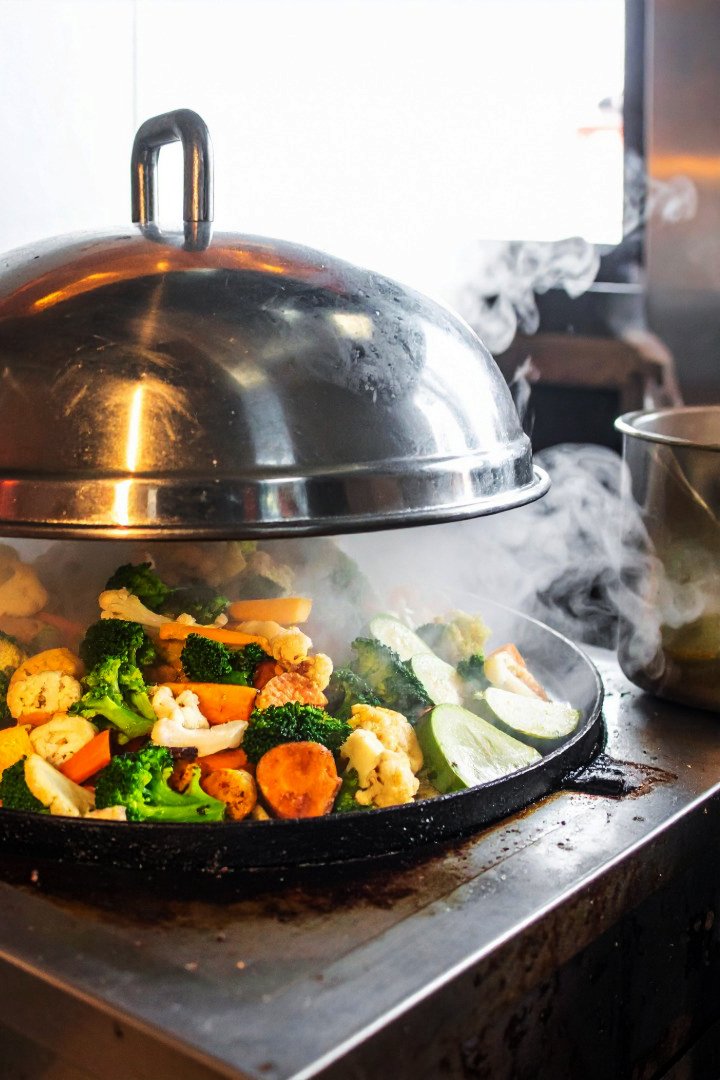
Steam griddling: the Asian shortcut to crisp-tender vegetables
Steam griddling solves a problem that pure searing cannot. Dense vegetables char on the outside before the interior cooks through. This technique, developed in Asia, combines dry-heat contact with rapid steam bursts.
Steven Raichlen documents the process in Barbecue Bible. Vegetables first cook in oil on a medium-hot griddle surface. A small amount of water is then squirted directly onto the plate. The water boils instantly upon contact. The resulting steam penetrates tough vegetable fibers from above. Meanwhile, the heated surface maintains caramelization underneath.
This dual-action method works best with specific vegetables:
- Broccoli florets develop charred edges while stems turn tender inside
- Winter squash slices cook through evenly without drying out
- Dense root vegetables like carrots and sweet potatoes soften in minutes
- Thick-cut eggplant rounds achieve the creamy interior prized in Asian cooking
Placing a dome or metal bowl over the vegetables traps steam. This accelerates cooking and creates a texture impossible through searing or steaming alone. The contrast between crisp exterior and soft center defines the technique.
Salt-searing: a Spanish method for perfect shellfish
Spanish chef José Andrés popularized a technique that transforms coarse sea salt into a cooking medium. A layer approximately one centimeter thick spreads across the griddle. The salt heats until the surface shimmers visibly.
Prawns are placed directly on the salt bed. The crystals absorb moisture from the shell exterior. Intense conducted heat reaches the flesh simultaneously. The result is a prawn with a crackling shell and barely-cooked center. This preparation reflects the traditional Spanish preference for shellfish.
The method extends beyond prawns to several other proteins:
- Whole fish fillets placed skin-side down develop a salt crust
- Thick-cut scallops benefit from the even heat distribution
- Octopus tentacles gain crisp edges against the salt surface
The salt layer can serve for several batches before replacement. After cooking, excess crystals are brushed off rather than rinsed. The residual seasoning adds a subtle mineral note to each dish.

Matching techniques to the right cooking surface
The distinction between plancha and griddle matters when selecting restaurant equipment for specific techniques. Each surface type produces different heat patterns suited to particular cooking methods.
A plancha concentrates maximum heat directly above the burner. Temperature decreases gradually toward the edges. This gradient lets cooks sear at the center and hold finished items at the periphery. Chrome-coated surfaces minimize flavor transfer between successive dishes.
Standard griddles distribute heat more evenly across the entire plate. This uniformity suits teppanyaki techniques perfectly. Consistent temperature across a large area matters for fried rice and okonomiyaki. Cast iron retains heat longest, recovering quickly when cold ingredients make contact.
Frequently asked questions
Can home cooks replicate teppanyaki results without professional equipment?
Home cooks can achieve teppanyaki results with a large cast-iron griddle or flat-top attachment for a standard stove. The critical factor is surface temperature rather than equipment size. Preheating for five to seven minutes at medium-high heat reaches the 350 to 400 degree range required. A heavy-bottomed pan works for single-dish preparations like okonomiyaki. The key is allowing the surface to recover heat between batches. Adding ingredients in small portions prevents the temperature from dropping too far below the ideal range for proper caramelization.
What is the ideal temperature for plancha cooking?
The ideal plancha temperature ranges from 400 to 500 degrees Fahrenheit, depending on the ingredient being cooked. Seafood like prawns and squid demands the higher end of this range. A brief, intense sear locks moisture inside the shell or flesh. Vegetables perform better at the lower end, around 400 degrees, which prevents charring before the interior softens. Testing readiness requires only a few drops of water on the surface. The droplets should dance and evaporate within two seconds. If they sit and steam slowly, the plancha needs more preheating time before cooking begins.
Which griddle technique works best for shellfish?
Salt-searing produces exceptional results with prawns, scallops, and whole fish. The coarse salt layer creates an even cooking surface that simultaneously seasons and sears. For more delicate fish like sole or flounder, the standard plancha method works better. A thin film of olive oil on a chrome surface prevents sticking while maintaining high-heat contact. The choice depends on the thickness and robustness of the protein. Thicker shells and denser flesh benefit from salt-searing. Thinner, more fragile pieces require the gentler direct contact of an oiled plancha.
How does steam griddling differ from regular steaming?
Steam griddling combines two cooking methods in a specific sequence. Initial dry-heat contact caramelizes the vegetable surface. This creates flavor compounds that are completely absent in traditionally steamed dishes. Brief water bursts then cook the interior without washing away the surface browning. Standard steaming produces uniformly soft textures throughout. Steam griddling yields a crisp exterior paired with a tender center. The contrast between these two textures is the hallmark of the technique. Dense vegetables like broccoli and root vegetables benefit most from this dual approach.
Conclusion
Four distinct griddle traditions, teppanyaki, plancha, steam griddling, and salt-searing, each offer specific techniques matched to signature dishes. The flat cooking surface remains the most versatile tool for bringing international street food flavors into a home kitchen.
Mastering one technique and its signature dish provides the fastest starting point. Okonomiyaki from teppanyaki or gambas a la plancha both require minimal ingredients and deliver restaurant-quality results on any flat heated surface.
Sources
- BusinessDojo – Street Food Market: Growth and Global Trends (2025) : https://dojobusiness.com/blogs/news/street-food-market-growth
- Barbecue Bible – The Five Best Techniques for Cooking on a Griddle (2025) : https://barbecuebible.com/2025/09/24/five-best-techniques-for-cooking-on-a-griddle/
- Michelin Guide – Kitchen Language: What Is a Plancha? : https://guide.michelin.com/us/en/article/dining-out/kitchen-language-plancha
- Japan National Tourism Organization – Okonomiyaki Guide : https://www.japan.travel/en/guide/okonomiyaki-guide/
- Benihana – Hibachi vs Teppanyaki: What’s the Difference? : https://www.benihana.com/blog/difference-between-hibachi-and-teppanyaki/
- KitchenFiftySeven – A Comprehensive Guide to A la Plancha Cooking : https://kitchenfiftyseven.com/what-does-a-la-plancha-mean-in-cooking/


Raymund – what an absolutely wonderful summary to read, keep and check when memory fails! Of the four methodologies I know very little about salt-searing and most about teppanyaki (basically Japan) and steam griddling (Shanghai) . A fantastic Sunday-school of a different kind ( :) ! ) I shall show friends!