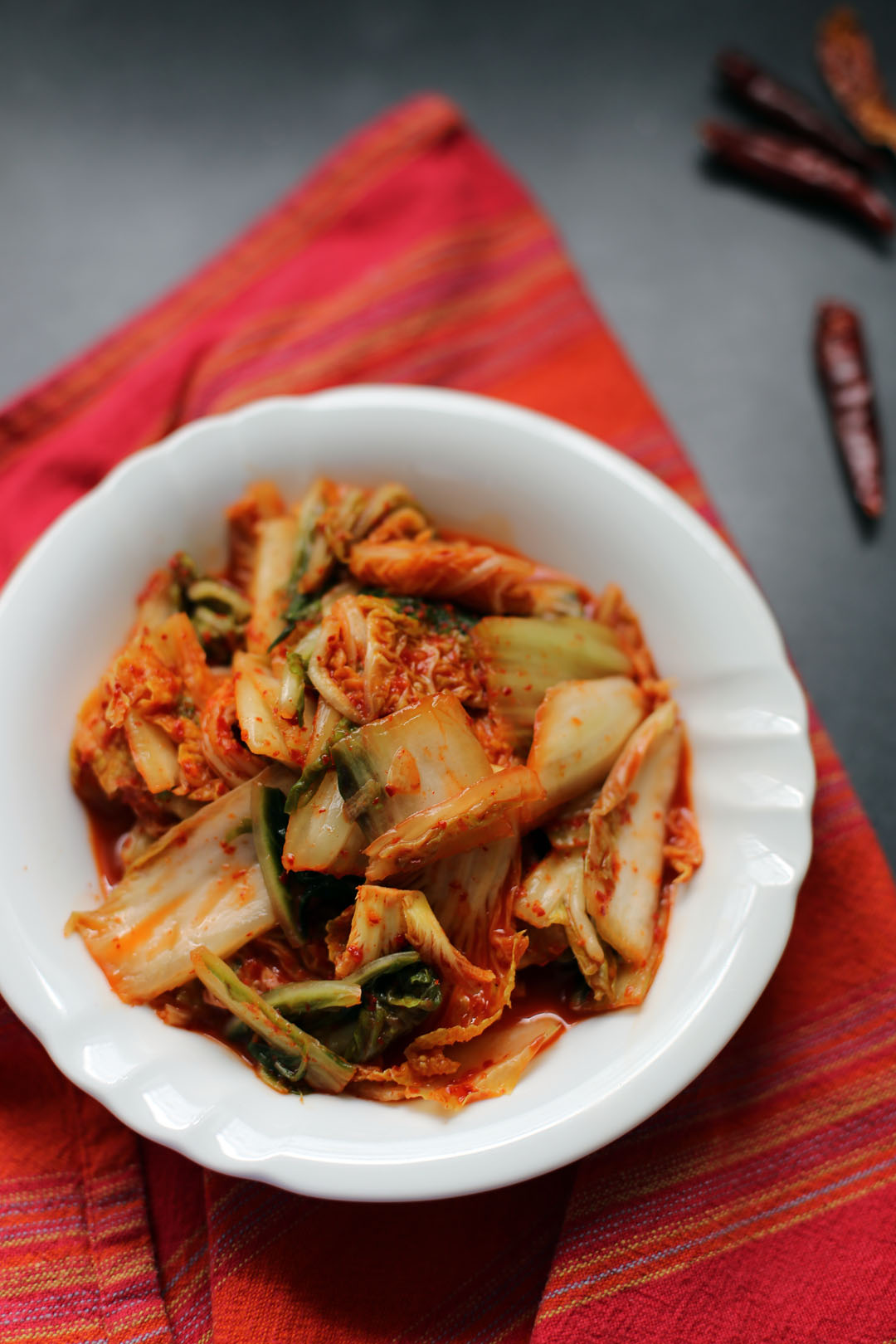
Napa cabbage fermented with gochugaru, garlic, ginger, fish sauce, radish, leek and salted squid for a classic Korean side dish. Today our kitchen turned into a small family production line. My daughter, being the Korean food enthusiast in the family, led the operation while the rest of us joined in salting cabbage, preparing vegetables and coating everything in that brilliant red seasoning.
Kimchi is probably one of the first foods that comes to mind when someone mentions Korean cuisine. It is served with rice, appears alongside countless meals as banchan, and can transform into an ingredient itself once it becomes properly fermented.
You can put it in Kimchi Jjigae, turn leftover rice into Kimchi Bokkeumbap, make pancakes with it or simply grab some straight from the fridge whenever a meal needs something sour, spicy and crunchy.
Despite eating plenty of Korean food over the years, making a large batch of proper kimchi at home feels quite different.
We made some today, and we did it almost like Koreans traditionally do it, as a family affair. Naturally, my daughter, who loves Korean food, led the way.
Considering the amount of cabbage involved, having extra hands certainly helps.
Kimchi Didn’t Always Look Like This
One thing I find fascinating about kimchi is just how much it has changed.
It is tempting to imagine that Koreans have been making the same brilliant red Napa cabbage kimchi for thousands of years, but that isn’t the case.
Kimchi developed from ancient methods of salting and preserving vegetables. Long before refrigeration, preservation was essential for surviving periods when fresh vegetables became scarce, particularly Korea’s cold winters.
Early forms were much simpler than what we recognise today. Salted and fermented vegetables provided a way to extend the harvest, but they didn’t have the fiery red colour we now immediately associate with kimchi.
Over time, additional ingredients and seasonings became part of the process.
Garlic, ginger and other aromatics helped create increasingly complex flavours, but another ingredient still had to arrive before kimchi could begin resembling today’s familiar version.
Chillies.
The Red Kimchi Came Much Later
Chilli peppers originated in the Americas and spread around the world through international trade after European contact with the Americas.
They reached Korea around the late 16th to early 17th centuries and gradually became part of Korean cooking.
That means the iconic combination of cabbage covered in red chilli flakes represents only one chapter in kimchi’s much longer story.
Eventually gochugaru, Korean red pepper flakes, became one of the defining ingredients in many kimchi varieties.
Today it is difficult to separate that beautiful red colour from our mental image of kimchi, but there are still Korean kimchi styles without chilli, such as Baek Kimchi or white kimchi.
Kimchi, therefore, is much broader than simply spicy fermented cabbage.
Baechu Kimchi
The version we made is Baechu Kimchi, the Napa cabbage variety that has become perhaps the most internationally recognisable form.
And we weren’t making a tiny jar. We started with 4.5 kilograms of Napa cabbage.
Once you start dealing with that quantity, you begin to understand why kimchi-making lends itself so naturally to being a communal activity.
The cabbage gets cut, soaked and salted, then turned every 30 minutes for about an hour and a half. Afterwards it needs several rinses and plenty of draining before you even get to the seasoning.
That is when the fun really starts.
Kimjang and Making Kimchi Together
Our little family kimchi-making session obviously wasn’t quite on the scale of traditional Korean Kimjang, but I like that there was a connection in the way we approached it.
Kimjang is the Korean tradition of communities and families coming together to prepare large quantities of kimchi, traditionally in preparation for winter.
It isn’t simply about producing food.
Knowledge passes between generations while people work together, and families maintain their own methods and preferences. In 2013, UNESCO inscribed the Korean tradition of Kimjang, making and sharing kimchi, on its Representative List of the Intangible Cultural Heritage of Humanity.
That communal aspect made a lot more sense to me once we started making our own batch.
This isn’t like making a sandwich for yourself.
When several kilograms of cabbage are sitting in front of you, company is useful.
In our case, my daughter was in charge. Considering her love of Korean cuisine, I was quite happy to follow instructions.
The Secret Ingredient Is Rice Porridge
One interesting part of this recipe is the sweet rice flour porridge.
Three cups of water are mixed with sweet rice flour and cooked until the mixture thickens and starts bubbling. Sugar goes in afterwards, and the whole thing needs to cool before you build the kimchi paste.
This mixture helps the seasonings cling beautifully to the cabbage.
Into the cooled porridge goes fish sauce, plenty of gochugaru, garlic, ginger and onion.
And when I say garlic, I mean garlic.
There is a whole cup.
This is not a recipe where two carefully measured cloves are going to do the job.
Fermented Squid Adds Another Level
Our version also contains salted fermented squid.
This adds another layer of seafood umami to the kimchi alongside the fish sauce.
Kimchi recipes vary enormously between families and regions, and fermented seafood can play an important role in many preparations. Salted shrimp, known as saewoojeot, is another familiar choice.
For this recipe, we rinse and drain the salted squid, chop it into small pieces and mix it directly into the paste.
Then come the vegetables.
Korean radish and carrot are julienned, while green onions and leek bring freshness and another layer of aroma.
Once everything comes together, that seasoning paste already smells incredible.
Then Comes the Messy Part
Now you need to mix it with all that cabbage.
This is why a very large basin helps.
The drained cabbage goes into the kimchi paste and everything gets mixed thoroughly until every piece receives a generous coating.
Gloves are also a very good idea unless you want your hands smelling like garlic, fish sauce and chilli for quite some time.
With a batch this large, working in smaller portions is perfectly fine if your bowl isn’t big enough.
The important thing is distributing that seasoning evenly.
Fresh Today, Completely Different Later
What I particularly enjoy about making kimchi is that the recipe doesn’t really end when you put it into the container.
You can eat it immediately.
Freshly made Baechu Kimchi is crisp, juicy and vibrant. The individual flavours remain easy to distinguish, and the cabbage still tastes very fresh.
In fact, this connects nicely with the Fresh Kimchi or Geotjeori my daughter made previously. Freshly seasoned cabbage has its own appeal before fermentation develops significant acidity.
But leave this batch to ferment and it becomes something else.
Lactic acid bacteria gradually transform the sugars in the vegetables, producing acidity and increasingly complex flavours. The cabbage softens, the flavours integrate and that unmistakable fermented kimchi character develops.
Let it mature even further and it becomes fantastic for cooking.
That older sour kimchi is exactly what I want for dishes such as Kimchi Jjigae or Kimchi Bokkeumbap.
So you almost get several foods from one batch.
A Family Project Worth Repeating
There is something satisfying about opening the refrigerator and seeing containers filled with something you made yourselves.
Perhaps even more so when the recipe itself has such a strong tradition of communal preparation behind it.
For us, it was also a perfect combination of interests.
My daughter got to lead us through one of the Korean foods she loves, while I got another big cooking project and a fridge full of something I can use in future recipes.
That’s a very good arrangement as far as I’m concerned.
And the best part is that we don’t even have to wait.
We can eat some crisp and fresh today, enjoy more as it develops over the following days, and save the properly sour stuff for cooking later.
Kimchi is a popular side dish in the Korean cuisine made out of fermented cabbage. Usually served with rice alongside other banchan (side dishes) but it can also be used as an ingredient in dishes like the spicy stew called kimchi jjigae and the kimchi fried rice called kimchi bokkeumbap.
2 1/2cupsgochugaru (Korean red pepper flakes), or to taste
Salted fermented squid, rinsed, drained and chopped, to taste
2cupsleek, chopped
10 green onions, diagonally sliced
1/4cupcarrot, julienned
2cupsKorean radish, julienned
Instructions
Trim and discard any damaged or discoloured outer leaves from the Napa cabbages.
Cut each cabbage lengthwise into quarters and remove the hard cores. Chop the leaves into bite-sized pieces.
Rinse or briefly soak the cabbage pieces in cold water, then transfer them to a large basin while they are still wet.
Sprinkle the kosher salt throughout the cabbage, tossing so it reaches as many pieces as possible.
Leave the cabbage to salt for 1 1/2 hours. Turn and mix the cabbage every 30 minutes so it salts evenly.
After salting, rinse the cabbage thoroughly in cold water three times to remove excess salt. Drain very well and set aside.
To prepare the porridge, combine 3 cups water and the sweet rice flour in a saucepan. Mix thoroughly before heating to prevent lumps.
Bring to a boil while stirring continuously. Cook for approximately 5 minutes, or until the mixture thickens and begins bubbling.
Add the sugar and continue stirring for another couple of minutes until the mixture becomes glossy and translucent.
Remove from the heat and allow it to cool completely.
Transfer the cooled rice porridge to a very large mixing bowl. Add the fish sauce, gochugaru, crushed garlic, minced ginger and minced onion. Mix thoroughly.
Rinse and drain the salted fermented squid, chop it into small pieces and add it to the seasoning mixture.
Add the chopped leek, green onions, julienned Korean radish and carrot. Mix until everything is evenly coated and you have a thick red kimchi paste.
Place the paste in a large basin and add the drained cabbage. Wearing food-safe gloves, thoroughly mix and massage the seasoning through the cabbage until every piece is well coated. Work in batches if necessary.
Pack the kimchi firmly into clean food-safe containers or glass jars, leaving some headspace because fermentation can create gas and cause the contents to expand.
You can eat the kimchi immediately for a crisp, fresh flavour or allow it to ferment until it reaches your preferred level of acidity.
Once it has developed to your liking, refrigerate it to slow the fermentation.
Notes
Kimchi continues changing after you make it. Fresh kimchi tastes crisp and vegetable-forward, while longer fermentation produces increasingly sour, complex flavours.
Fermentation speed varies considerably with temperature, so judge readiness by aroma, flavour and visible fermentation rather than relying only on a fixed number of hours.
The quantity of gochugaru can be adjusted to taste, although reducing it significantly will also change the consistency and overall character of the seasoning paste.
Because this recipe contains salted fermented squid, use properly prepared squid intended for this type of Korean fermented preparation rather than simply adding raw squid.
Don’t throw away a batch just because it becomes very sour. Well-aged kimchi can be even better than fresh kimchi for Kimchi Jjigae, Kimchi Bokkeumbap and other cooked Korean dishes.
I love your kimchi recipe and it even sounds simple enough that I might give it a try. Our family and especially the boys love spicy Korean food and it just would not seem right without a little kimchi on the side. Have a super day!
An acquired taste. Everybody’s favourite…just not mine. My Auckland friend took me to a Korean place there to eat this – she wanted to change my mind about it but I did not like. She was so annoyed. LOL!!! http://suituapui.wordpress.com/2012/12/31/arirang/





Oh, I do love kimchi – have a collection of recipes! but haven’t tried making it yet.
I love your kimchi recipe and it even sounds simple enough that I might give it a try. Our family and especially the boys love spicy Korean food and it just would not seem right without a little kimchi on the side. Have a super day!
Damn deliicous, hot, spicy, tangy and crisp kimchi, totally a korean food porn!!!
great job Ray…..
THIS looks phenomenal, full of wonderful probiotics too! ;)
We’ve had this on our list of things to make. When we get to it, I think I’ll try your version!
I adore kim chi, I always have a jar of it in my fridge but never tried to make it before. This is quite inspiring.
An acquired taste. Everybody’s favourite…just not mine. My Auckland friend took me to a Korean place there to eat this – she wanted to change my mind about it but I did not like. She was so annoyed. LOL!!!
http://suituapui.wordpress.com/2012/12/31/arirang/
Your kimchi looks so good, Raymund! I haven’t tried homemade yet, but one day!!
‘Kimchi’ recipe looks so delicious.
Now I can make it at home.
You need to make this now, not later, lol. You will love it.